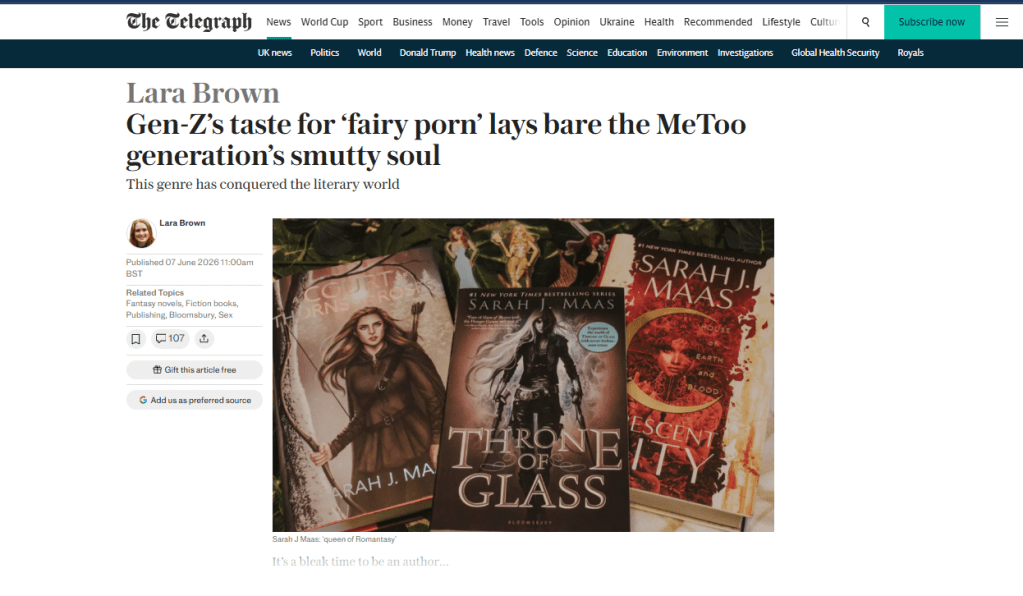
After reading Laura Brown’s recent Telegraph article, “Gen Z’s taste for fairy porn lays bare the MeToo generation’s hypocrisy“, I have thoughts. Quite a few, actually. Lets get into it.
The Telegraph recently described romantasy as “fairy porn”, reducing an entire genre to a lazy stereotype. Here’s why that argument misses the point.
I’ve been a reader for over twenty years. During that time, I’ve watched countless publishing trends rise and fall, including the explosive growth of what you so eloquently describe as ‘fairy porn’. I have many issues with your article, firstly your definition of Romantasy is so weak, it barely resembles the genre that us readers actually engage with. It makes me wonder if you ever actually read any of the books you’re writing about, because saying these books have no world building or plotline is not only insulting to the authors who spend significant chunks of time crafting them but highly inaccurate and disingenuous.
Putting Sarah J. Maas under the label of Romantasy shows the exact oversimplification that frustrates me and many fantasy readers, while ACOTAR fits neatly into Romantasy, Throne of Glass is fundamentally an epic fantasy where romance is a takes a backseat over the central narrative, the same can be said for Crescent City.
“Romantasy is the commercialisation of previously self-published serialised erotica found on sites like Wattpad” I don’t even know where to begin with this statement… I’m just going to say that while yes some successful Romantasy authors did come from online communities, putting all books in this basket ignores the variety of books being published under this label today.
And then we have your ableist views: “Romantasy seems to have been crafted in a lab for the terminally online Gen Z and Millennial reader. This may be why so many of its protagonists, bizarrely, seem struck with chronic illnesses.” What exactly is wrong with characters having chronic illnesses? What’s wrong with giving people who have these conditions representation in the stories they are reading? You seem to think that protagonists with chronic illness are so unusual that you need a reason for them to be there, while ignoring that readers with chronic illness actually exist and that representation of them in the books they are reading is vitally important.
The theme of your article seems to be you trying to reduce an entire genre to its most scandalous elements and then criticising it like it represents it as a whole. You say, “But it’s hard to square this oft repeated feminist claim with their actual content: coercion, kidnap, and sometimes all-out romanticised rape.” You assume that the depiction of these topics is an endorsement, when fiction has always explored uncomfortable themes and dynamics. Readers are perfectly capable of distinguishing between fantasy and reality. Enjoying a fictional dynamic is not the same as endorsing it in real life
Lastly you ask, is there difference between having “lads” mags on a table or Romantasy books? And I’m lost as to what point you are trying to make? It’s 2026. Can we stop shaming women for enjoying things? Lads mags, which showcase real women, whose bodies are presented for male consumption are wildly different to fictional stories consumed primarily by women. This comparison doesn’t just fall apart under scrutiny, it reveals the very prejudice at the heart of your article: a continuing discomfort with the things women choose to read, enjoy and discuss.


Bravo and well-said!
LikeLiked by 1 person
Thanks 🙂
LikeLike
Fantastic post! Absolutely this! I can’t believe after this I saw another article about Romantasy and how it’s such a recent thing that needs to be put to bed. This genre has been around, and popular, for DECADES! We just didn’t call it Romantasy at the time! Just let people enjoy what they enjoy!
LikeLiked by 2 people
Thank you. I saw that other article as well, it’s absolutely crazy! I agree with you, I swear most of these articles are just rage bait.
LikeLike